

For more than two decades, LinkedIn has owned the professional graph but companies still struggle to use it to find the right partners. Partnership managers spend most of their day just researching potential leads.
Microsoft, Salesforce, and HubSpot built empires on partnerships. Yet for the vast majority of startups, the channel remains opaque, inefficient, and almost impossible to scale.
The reason isn’t ambition. It’s infrastructure. And it’s why a small London start-up, Souk, believes LinkedIn, the de facto tool for professional search, is about to be disrupted from below.
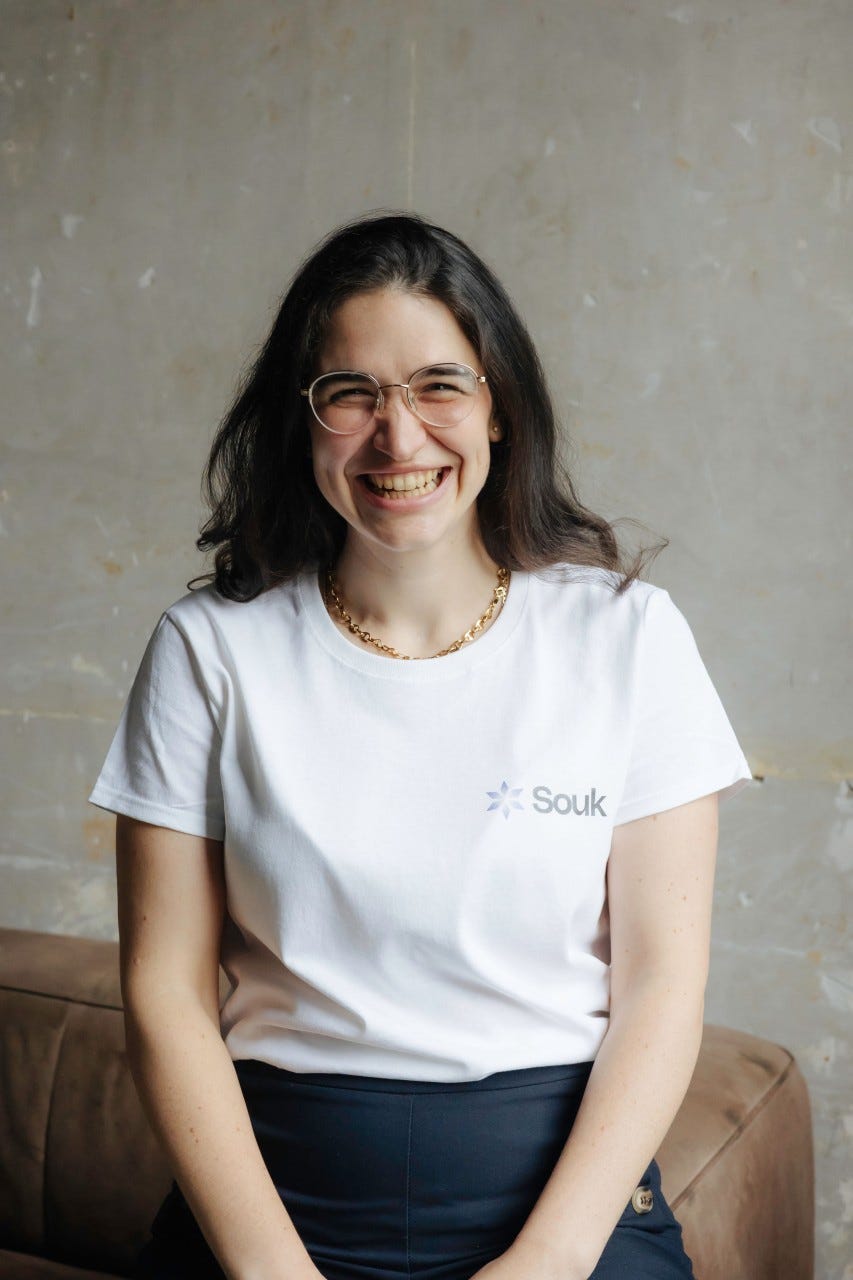
Founded earlier this year by former investor Sofia Hamilton, Ayooluwa Alfonso, who’d built infrastructure at GitHub and Leo Crowe, whose background was in partnerships and sales, through the Antler accelerator; Souk is rebuilding the infrastructure of how companies find and manage partners from the ground up, using live AI search instead of static data.
Hamilton didn’t set out to take on LinkedIn. When she joined Antler in April, she was looking for “the right people, then the right idea and then the right solution.” But in a room of ninety potential founders, she met two who would help her stumble into both: the broken infrastructure behind how companies grow.
When Crowe described the partnership space, the challenges, the inefficiencies, the massive untapped potential, Hamilton felt something click. “I had sparks flying in my head because I was like, oh my god, this is such a great opportunity to actually expand and diversify the potential customer base we’re going to be dealing with.”
As an ex-investor, the appeal was visceral: “You’re putting all your eggs in one basket as an operator, but if you can potentially serve a really broad segment of customers, then you have sort of diversified that risk.” What they were chasing wasn’t just a business opportunity. It was a fundamental question about how modern companies grow, and why the infrastructure to support that growth had been left behind.
The 90% problem nobody’s solving
Microsoft generates more than 90% of its revenue through partnerships. Salesforce and HubSpot derive around 45% from them.
These aren’t outliers, over the past 20 years, the biggest companies that have become globally known have done so through partnerships. But for most businesses in the Series A to D range, that long tail of growing companies that represent the bulk of the start-up ecosystem; partnerships represent somewhere between zero and 30% of their revenue mix.
The most successful in Souk’s target market hover around 30%. Most are far below that. “Partnerships is the way for businesses to grow at an exponential rate,” Hamilton says. “But the problem is it’s not very accessible to most businesses because it’s very time consuming and it can be very hard to see the return on investment.”
The math is brutal. The typical stat: 90% of the partners in a partner ecosystem will not be generating any revenue at all. Partnership managers spend three to four hours per day, 40 to 50% of their entire workday, just trying to find the right people.
And even after all that prospecting, the hit ratio is devastatingly low. “So how do you validate the time you’re spending to find all these people, to keep them active, when it’s not like a really high hit ratio of them actually sending you deal flow?”
Hamilton asks. “Those are some of the problems that we’re trying to fix for this space.”
The wrong problem, the right pivot
In their first week, Souk did more than 40 validation calls with businesses ranging from pre-seed to Series D to companies just coming up to IPO. Problems existed at all stages, but the question became: where could they actually earn the right to play?
“Who’s gonna let me test with them? Who’s gonna give me data in order to integrate? Where can I add value?” Hamilton recalls. The coaches at Antler pushed them: really hone in on where you can 10x a particular metric for your potential customer.
They started with what seemed like an obvious pain point: keeping partners active. This was the gray area where sales reps and partnership managers constantly debated deal attribution, did I bring them in, or did you?
Tracking was either nonexistent or poor. Souk’s initial solution was to integrate into Slack channels and become a single source of truth, making it easy to search existing partner databases. Potential pilot users were interested. But it wasn’t going to 10x anything compared to other players in the ecosystem. Worse, it could be easily replicated. “In fact, we saw it during one of our validation calls,” Hamilton remembers. “There was a company who had hired someone who had actually built a very similar framework for their own business. But because in this industry tenure is so short, it’s like a year to a year and a half average lifespan of someone in that role, they’d let that person go. There was no one to maintain the infrastructure. It broke down and never got used again.”
If businesses were already dabbling in building this out themselves, Souk needed to do something better. Something harder to achieve. Something that gave them the right to exist.
“It was in that discovery process of realising, okay, what can we do where it’s a bigger leap forward in terms of the value proposition, that we realised there is this capacity for us to be much, much better at finding than any potential tool that is being used internal to the business and even external to the business.”
External to the business meant LinkedIn Sales Navigator, the incumbent, the legacy tool that partnership managers were already using for prospecting. And that’s when things got interesting.
The trailblazer’s bet
Anne Boden was 54 when she decided to start a bank from scratch. Investors told her it was impossible. The last new UK bank charter had been granted in 1840. Existing banks had every advantage: capital, customers, centuries of regulatory relationships, brand trust built over generations.
She was right anyway.
What looked like incumbent advantages, branch networks, legacy IT systems, established business models, turned out to be incumbent liabilities. Starting fresh wasn’t a disadvantage. It was the only advantage that mattered. Boden could build for mobile-first because she wasn’t maintaining systems designed for physical check deposits.
Sofia Hamilton is making a similar bet, and facing similar skepticism. LinkedIn doesn’t just dominate professional search; it essentially is professional search. Telling people you’re going to out-search LinkedIn using LinkedIn’s own data sounds, on its face, absurd.
But Hamilton has studied this playbook. As an ex-investor, she watched Boden, then Monzo, then Revolut prove the same thesis: when legacy infrastructure becomes a cage, starting fresh beats iterating.
The question isn’t whether LinkedIn has advantages. It’s whether those advantages have become liabilities.
“You’re better at LinkedIn’s database than LinkedIn is”
When Anne Boden started Starling Bank, people thought she was mad. You can’t out-bank the banks, they said. They have everything: capital, customers, regulatory approval, decades of infrastructure.
Boden’s insight was that ‘everything’ had become the problem. Legacy infrastructure meant legacy thinking. She could build for mobile-first because she wasn’t maintaining systems designed for branches.
Sofia Hamilton is betting on the same dynamic. LinkedIn has everything: the professional graph, the data, the users. But that means they’re trapped by a pre-AI architecture they can’t afford to replace
The problem isn’t data; it’s design. LinkedIn built for a pre-AI era, and changing that now would mean destroying its own revenue model.
“I think the thing with legacy companies, they have all of the data, they have a lot of data, but they struggle to process it,” Hamilton explains. “And in order for them to change the way that they’re doing things, they almost have to cannibalise their own revenue and their own product segment.”
Classic innovator’s dilemma. LinkedIn built Sales Navigator for salespeople, as the name suggests. It works through prescriptive filtering: headcount, region, job title.
You narrow your search by checking boxes and selecting from dropdown menus. It’s a system designed for a pre-AI era, and updating it would mean admitting the core product is outdated.
Souk rebuilt the entire search infrastructure from scratch, specifically for partnership managers, using an AI RAG (Retrieval-Augmented Generation) model that accesses the live internet rather than static data snapshots.
“Most LLMs are trained on a particular snapshot of data, I don’t know when ChatGPT was last updated, but it’s up to a certain point,” Hamilton says. “Whereas what our system has the capacity of doing is accessing the live internet and scraping through all the details.”
The difference becomes tangible in a simple example: hiring signals. LinkedIn’s system can only find that someone’s hiring if that person explicitly updates their profile to say “I’m hiring” and self-selects into that category. Souk’s system scrapes public information across social media. If someone posts “looking to hire someone in fintech” on any public platform, Souk catches it.
“That’s public information that we can trace back and say, look, this is someone that is looking to hire someone in this space,” Hamilton explains. “And actually, we have users in the recruitment sector who say, ‘You’re actually more effective at going through LinkedIn’s database than LinkedIn is at going through their own database.’
“Which is a great point of information for us,” Hamilton says, with characteristic understatement.

The natural language revolution
But the real breakthrough isn’t just better data access. It’s the interface, specifically, natural language search. Instead of filtering by prescribed categories, you can simply type what you’re looking for in plain English: “I’m looking for fintech managers in London who like running and that we should invite to our 10k next month.” The system returns exactly that. And here’s the crucial part: you haven’t just found the right people. You’ve simultaneously found your personalisation angle.
“You don’t have to go, ‘Well, how am I going to reach out? How am I going to build a relationship with this person from a cold start?’ You already know something about them that will help you bridge that gap.
”Hamilton’s favourite feature takes this further: enrichments. These are AI-powered insights that surface additional personalisation about individuals. Her go-to enrichment is “give me a fun fact about this person.”
“Sometimes the fun fact about an accountant will be some qualification they have, which is maybe not the most fun thing,” she admits. “But it still gives you some frame of reference about who they are and what they’ve pursued and what their ambition is. But for some people, it gives you a fun fact like, ‘back in 2014, they were ranked 40th globally in sailing.’”
That sailing fact, something that would have taken hours of manual research to uncover, appears in seconds. It’s the kind of specific, unexpected detail that transforms a cold outreach into something genuinely personal.
But Hamilton sees something deeper happening: “It helps make them a real person. Rather than just seeing profile after profile after profile of potential candidate, you’re seeing a real individual who has this life outside of just being a target for you to outreach to. That’s something that I think is actually really value additive to our users because it just makes their day job more interesting.”

From three hours to three minutes and then something unexpected
The efficiency gains are staggering. Partnership managers who spent three to four hours per day on prospecting now get the same results in minutes.
But Souk discovered something counterintuitive: users aren’t saving time and logging off. They’re staying on the platform longer. “Because they can now get the right hit rate so much faster, if they were targeting to get 20, 30, 40 people in one day, they can now do a lot more volume,” Hamilton explains.
“They’re inclined to stay on our platform for longer because they just feel more productive. We have both reduced the total amount of time that they need to spend on a task relative to a particular key performance indicators, but also they find themselves wanting to remain on the platform longer to actually achieve more.
“The business impact goes beyond time savings. For companies not successfully executing partnerships, it’s ultimately about revenue generation, moving from that 0-30% partnership revenue mix toward the levels that successful companies achieve.
“It’s just about giving them the right tools that will allow them to execute properly,” Hamilton says. “And once you’ve got better revenue generation from this channel, you can then also expand the team.”
The Small Business Saviour?
Perhaps Souk’s most profound impact is democratisation.Large enterprises have always had the resources to build robust partnership programs. They hire teams of partnership managers, build internal tools, absorb the inefficiency. For them, partnerships are a luxury channel that pays dividends at scale.
But for a 10-person company, the kind of early-stage startup that’s resource-constrained and fighting for survival, dedicating someone full-time to partnerships has been functionally impossible.
“We’ve got a couple businesses who are still very, very small, like 10-person teams, who don’t have the cost capacity to hire an entire partnership manager,” Hamilton explains.
“But actually, the chief executive of the business can now do a lot of this work effectively themselves because it doesn’t take up half their day, so it is making it more accessible for other businesses that are maybe just smaller in headcount to actually approach.”
Souk’s greatest disruption isn’t technical; it’s economic. It turns partnerships from a corporate luxury into everyday infrastructure.
The design philosophy: less is more in building Souk, Hamilton and her co-founders have been deliberate about what not to build.
“A lot of these platforms kind of grow arms and legs. They become kind of behemoths of features that actually can be really, really distracting and you don’t really know where to start,” she says. “Whereas for ours, what we’re really aiming to do is to be a very straightforward funnel.”
The interface is clean, with simple navigation. “Our home nav, it’s very clean. There’s not like a thousand tabs and a thousand sub tabs beneath that. Obviously the product is growing and there’s more features being added on a day-to-day, but we are very conscious of the fact that if it’s not adding value, or if someone else has already tried it, we don’t need to be adding every feature that’s out there.”
Hamilton, like many founders, employees and business leaders, have been on the receiving end of bloated product demos. at one stage of their career: “I’ve been on some demo calls with people where they’re like, ‘and then this feature, and then this feature.’ And I’m like, dude, I already forgot the third one because I’m trying to follow what you’re saying, but there’s so many potential things you want me to do here.”
The typical response from bloated platforms: don’t worry, we’ve got an academy where you can spend an hour watching videos on how to integrate and properly use all our features.
“I’m like, I don’t want to spend an hour of my life learning how to use your platform. Your platform should be straightforward enough that I can do it step by step, right?”
This philosophy extends to feature development. Souk launched a new feature based directly on user feedback: contact importing.
One user had a database of 16,000 partners. “But the problem is, actually only 300 of them are sending us anything of value,” Hamilton explains. “So they have this enormous long tail of potential partners that at some stage in their history they’ve had a relationship with. But over the last year, two years, three years, they’ve had no contact with. And they’re like, ‘We don’t know who is worth getting back in touch with, who actually we need to completely delete or replace with a new point of contact.’”
Souk built a solution for importing contacts so users can bring them in, find something interesting to re-engage over, and do that efficiently. “Obviously you’re not going to want to do that with 15,700 people one by one and look for a personalisation with each individual.”
Every feature launch follows the same principle: does this 10x something meaningful? If someone else has already tried it, why would Souk need to replicate it?
“We really just want to focus on the features whereby we can create meaningful additional value because there’s so many alternatives for everything else.”

The accidental recruitment discovery
Not every insight came from the original vision. Some came from unexpected users. Souk initially approached recruitment firms as test users. The logic was straightforward: recruiters are in contact with lots of people at once, they’re essentially “partnership generators” with broad networks, and they’re very effective at leveraging and monetising those networks.
“As a sub-segment of industry that already participates in partnerships in one way or another, we wanted to sort of sense check, okay, well how could this potentially fit our model?” Hamilton explains. “They’re not the primary use case, but it is really interesting to see how different ICPs will use your software.”
What they discovered was that recruiters weren’t just validating the partnership use case, they were finding Souk more effective for their core recruitment work than their existing tools.The feedback loop has been valuable: “So far it’s giving us a lot of additional information about quite how powerful is what we’ve built.”
It’s a classic sign of platform potential: when your tool solves problems you didn’t even know existed, you’ve built something fundamentally flexible.

Strategic angels and the partnership paradox
Souk is currently raising an angel round, and even their fundraising strategy reflects their product philosophy.“We already have a portion of our SEIS committed to some strategic angels who we’ve reached out to because they themselves have really powerful networks, either within VC investment spaces or within the SaaS space,” Hamilton explains. It’s the most powerful way to do a raise: “Not only are you receiving capital from them, but now they are also incentivised to share their networks and get you additional customers. So in a way, it’s a type of partnership, right?”
The meta-irony isn’t lost: a company building partnership tools is using partnerships to fuel its growth. The angel round will carry them through quarter one, when they plan to do their institutional round.
The organic American and what it signals
Then came the moment that every founder dreams about. Souk’s very first completely organic paying customer came from the Midwest in the US. Nobody on the team knew them. There was no introduction, no warm lead, no connection through the network. “We were just speaking between us like, ‘Do you know this person?’ ‘No.’ ‘Do you?’ ‘Do you?’” Hamilton recalls. “It was such an exciting moment because we were like, there is literally no link. There is no link between any one of us and this individual.”
Now they’re seeing an organic segment of Americans discovering Souk. “Which is really, really exciting. And our plan is to expand into the US.”
Currently, the majority of our users are based in the UK, with some coming from EMEA, particularly France. But that random customer from the American Midwest signals something crucial: the problem Souk solves isn’t regional.
It’s universal. Partnership inefficiency doesn’t respect borders. Neither does the solution.
The vision: your co-pilot for partnerships
Ask Hamilton about the long-term vision and she’s clear, even if she shies away from buzzwords: “Long term, the goal is to have a system that is your co-pilot. It is working alongside you.” Souk aims to be a single source of truth for partnerships through three pillars:
Finding the best quality partners using natural language search and AI-powered enrichment.
Keeping partners active, by giving visibility into the value being delivered and helping negotiate additional deal flow.
Managing partnerships, from contracts to payment flows, so companies avoid legal or financial missteps.
They’ve built the first pillar because that’s where they could deliver 10x value immediately. The others will follow. “This really cool piece of tech allows you to find the best possible partners through natural language,” Hamilton explains.
Redefining an outdated system
Partnerships have been stuck in 2010. Large enterprises can absorb inefficiency with dedicated teams and internal tools, but for small start-ups, partnerships were almost impossible to run effectively.
Souk changes that, turning partnerships from a corporate luxury into accessible infrastructure. Chief executives at 10-person companies can now do work that previously required a full-time role. Even recruitment firms, initially an unintended audience, are discovering new ways to use the platform.
The ultimate proof came from a single paying customer in the American Midwest, entirely organic, no warm lead, no introduction. That one user signals what Hamilton calls a universal truth: the problem is global, and the solution scales.
The bigger picture
“We’re very much trying to build geared on what has inevitably become the problems of legacy businesses,” Hamilton says, drawing parallels to how Monzo, Revolut, and Starling disrupted traditional banking. “I don’t need a bank in person. I’m very happy with it all to be on my phone. In a way, we’re trying to make it a better experience for partner managers so that it’s just more effective and better return on time spent.”
The comparison is deliberate. What Starling did for current accounts, stripping away bureaucracy, rebuilding trust, and rethinking the entire user experience, Souk is doing for partnerships.
Anne Boden proved that when you start from scratch, you can outpace institutions with billions in resources. Souk’s founders are following that same logic: no legacy code, no legacy business model, no legacy mindset.
The transformation is already visible. Partnership managers who once spent half their day manually prospecting now do it in minutes, and stay on longer because they feel more productive.
Small companies that couldn’t afford dedicated teams can now run partnership programs themselves. Even recruitment firms, never the intended audience, are finding new ways to use the platform.
And then there’s the signal every founder dreams of: a paying customer from the American Midwest, entirely organic, no warm lead, no introduction. That single user, found through nothing but need and discovery, represents more than revenue. It’s proof that the problem is universal, and the solution scales.
LinkedIn has the data, the users, the resources, and the brand. But it’s trapped by its own success, the classic incumbent’s curse. To rebuild itself would mean cannibalising the very product that made it indispensable.
Souk doesn’t have those constraints. It’s moving fast, building live, and designing for how people actually work now.
Just as Starling redefined banking for the mobile era, Souk is redefining partnerships for the AI age.
The disruption isn’t coming. It’s already underway and Souk is the one leading it.


